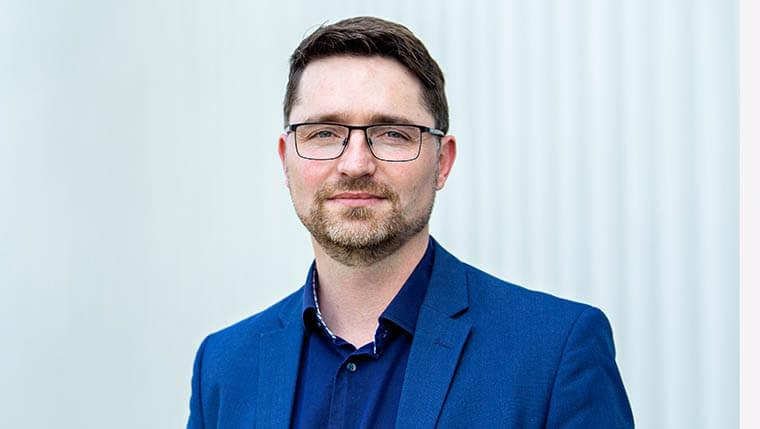
We speak to Robert Lumme, building biologist and architect at Baufritz, about his role and the career path that has brought him there.
Please tell us a little about yourself and an outline of your job.
My name is Robert Lumme. I am an architect with over 20 years of work experience. I have worked in different sectors of the industry, in small and large architectural practices. My work has included commercial, educational, residential and leisure projects. My job is to advise potential Baufritz clients who want to build an ecological house. Sometimes I do the design for the house, which is where my experience and training as an architect comes in handy. The benefit is that I know with Baufritz how much the houses will cost whilst I am designing them.
Another aspect of my job is building biology. Building biology is basically the science of healthy buildings. Meaning that in your living environment, dwelling, offices, places that you use, you avoid any toxic materials, any unnecessary VOCs (volatile organic compounds), which are usually found in paints, solvent and flooring. To sum up, my job is to assist our clients, to go from day one, when the client makes the first enquiry up until the hand over of the house. I make sure everything runs smoothly and they get the house they want.
What education and previous jobs have led you to this position?
I studied architecture in Germany and finished my degree with a Diploma in Architecture. Throughout my career I’ve always been interested in healthy ecological buildings, so that buildings are constructed in a way that is good for the environment and the user. I did a course to become a building biologist, learning about healthy building and healthy living. I found this job with Baufritz through a bit of luck, not because I am German, but through another architect who knew Baufritz and told me that there was a vacancy and it went from there.
What are the particular tasks and challenges in your role that you find most rewarding?
With each project comes tasks and challenges that are rewarding. For instance, if I am designing a house there is always the challenge for the house to work practically very well for the client and to meet their design aspirations. It is really rewarding to have designed the house, been through the planning stages and then for it to be implemented in the way you’ve designed it and the client envisaged it. If you have the result at the end where you can look at the house the way you’ve designed it, now that is really satisfying.
Another task is to make sure the project comes in on budget, whether we are working with another architect or I am designing for the client. I will always make sure the house is planned as efficiently as possible whilst it fulfils all the other aspects of the design.
Is there one project you have worked on that you are most proud of?
This is hard to say, as I am proud of all the projects I work on. I am most attached to the projects where I have done the designs myself and probably I am most proud of a project in Kent. It is called the Weald House, referring to the area. The client had a clear, very strong vision of what they wanted and what they didn’t want. It has been shortlisted for several awards and actually won Best Eco Home with Homebuilding and Renovating in 2016.
Another project I am proud of is one of my first buildings with Baufritz. This is a house in Hampshire called House Frankel. The client and I built a very good relationship from the beginning. And I would say we are now friends.
Is yours a unique job, and what chances would someone have to find one like it?
The job is definitely unique insofar as I am not just selling houses to people but I am able to use all my knowledge about architecture and building residential homes, together with my knowledge as a building biologist for healthy and ecological buildings. I advise the clients from A to Z to make sure they get the house they want, that it fulfils their needs and that they are happy with it.
Were you encouraged to work in construction-related jobs when you were young?
I was not particularly encouraged to work in construction related jobs when I was young but explored different routes myself. I carried out placements in various jobs and locations. One was working as a care assistant in a location for people with special needs, connected to a farm. There were lots of hands-on jobs including how to build things, understanding how things work on the farm and what processes had to happen and when. I also started an apprenticeship as a joiner before studying for my degree but couldn’t finish it because I needed to start my university course. During that year I learned a lot about joinery and building in general, because we were working on building sites, including putting roofs on and repairing stairs. That was very good experience and partially led me to the decision to study architecture.
From your experience, and what you hear from friends, is working at Baufritz different from other companies?
Working at Baufritz is different insofar as Baufritz has a very strong philosophy to be an inclusive company. It is a family-run company, that follows through its principles of healthy building and living in all aspects of how the company is run and is constantly working to improve that. This is really one of the major reasons I’ve joined them, otherwise I might have not been too interested in working for a prefab company, as some people may put it, but to learn about Baufritz excited me. I was very happy and very lucky to get a job here.
What’s your advice for someone who wants to qualify for a job like yours?
My advice is to look for routes in education that you need e.g. architecture, building technology, sustainable design. Even if you end up in a job where you only advise people on how to build and how to go through projects like the ones we are doing, it is always good to have a fundamental knowledge about the subject you are advising on. I very much recommend having a solid education in any building profession. Anything you can pick up along the way in terms of seminars, courses, CPD, go for it. Even when you are already working in the job… just go for it.