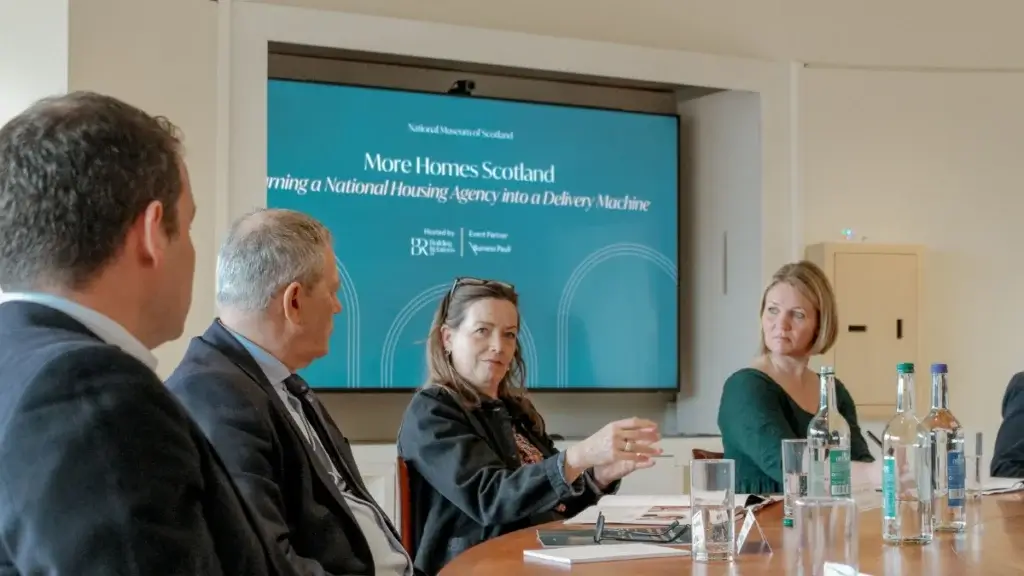
Scotland’s proposed new national housing agency, More Homes Scotland, must be given a clear mandate, formal powers and a practical delivery role if it is to help tackle the country’s housing emergency, according to a new industry report.
The recent report, ‘More Homes Scotland: Turning a National Housing Agency into a Delivery Machine’, produced by Building Relations PR and Burness Paull, captures the findings of a roundtable discussion held in Edinburgh in April with leaders from Scotland’s housing, planning, development, investment and policy sectors.
It finds that Scotland’s housing challenge is not a lack of ambition, but the need for greater alignment across land, infrastructure, planning, finance and policy.
The report comes as housing delivery remains one of the biggest challenges facing the Scottish Parliament. It reveals support for the ambition behind More Homes Scotland and warns that the agency risks becoming another blocker unless it is empowered to remove barriers, coordinate decision-making and unlock stalled delivery.
The latest Scottish Government housing statistics show that housebuilding activity fell by 13% in 2025 to 17,336 completions, while starts fell by 6% to 14,999.
Affordable housing delivery is also under pressure. The latest figures show that Affordable Housing Supply Programme completions fell by 25% in 2025, with starts down 15% and approvals down by 9%. As of December 2025, 32,479 affordable homes had been delivered towards the Scottish Government’s target of 110,000 affordable homes by 2032.
The report argues that Scotland’s housing challenge is systemic, rather than confined to any single part of the sector. Participants said delivery is being held back by a fragmented system in which decisions on land, planning, infrastructure, finance and public policy are too often made separately, adding delay, cost and uncertainty to already complex projects.
The report calls for More Homes Scotland to be designed as a practical delivery body, which it hopes will give it the authority to coordinate across government, local authorities, infrastructure providers, funders and developers. Key recommendations include giving the agency a clear purpose, intervening earlier on stalled sites, improving routes to land and patient capital and ensuring policy ambition is tested against viability and deliverability.
The report also calls for housing to be treated as economic infrastructure, recognising its role in growth, labour mobility, health outcomes, productivity, regeneration and community resilience.
Participants highlighted several immediate barriers to delivery, including constrained land supply, inconsistent planning interpretation across Scotland’s 32 local authorities, fragmented infrastructure approvals, policy layering, viability pressures and a lack of long-term patient capital for smaller builders.
Industry bodies have also warned that the current trajectory is worsening. Homes for Scotland has said the latest official figures show Scotland’s housing emergency is continuing on a ‘catastrophic trajectory’, with its research pointing to an insufficient pipeline of deliverable housing land to support the level of all-tenure home building Scotland requires.
Rachel Colgan, founder of Building Relations, said: “This report captures a clear and urgent message from across the sector. Scotland does not lack ambition when it comes to housing, but it does need a more joined-up, practical and empowered system for delivery.”
“More Homes Scotland has the potential to be a catalyst for real change, but only if it is designed with authority, clarity and commercial credibility from the outset.”
Louise Chambers, real estate partner at Burness Paull LLP, said: “Key sites which could deliver valuable housing can be held back by fragmented ownership, existing infrastructure constraints or other related issues, and could be addressed differently. At the moment that burden falls on the developer, which adds more time, more cost and more viability pressure.”