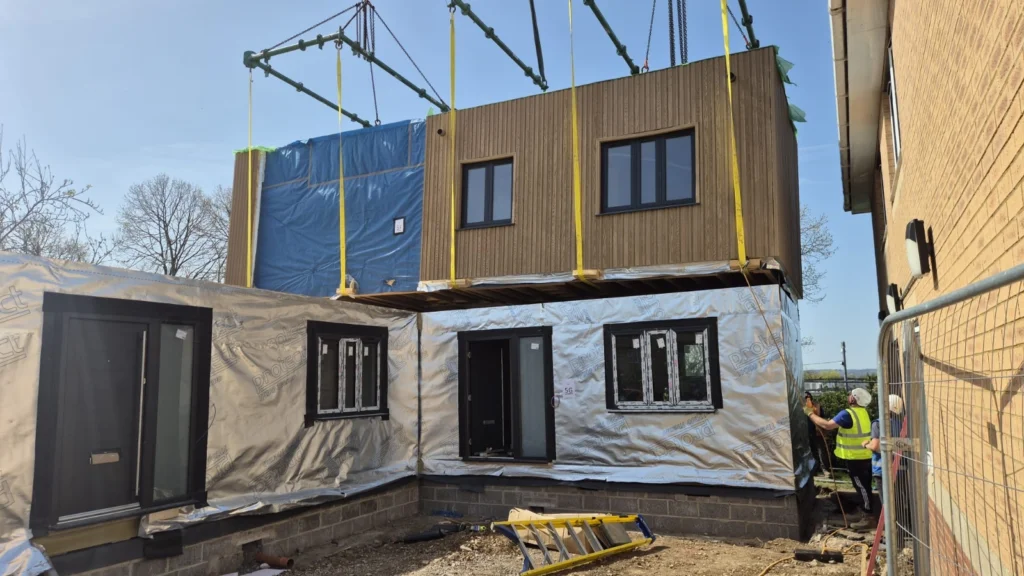
Chris Kane MP has described offsite timber frame construction as “vital” in achieving the government’s 1.5 million homes target as he visited Deeside Timberframe’s newly expanded manufacturing facility in Throsk, Stirling.
The MP’s visit follows Alex Rowley MSP’s tour of the facility, with both attending to discuss the role that MMC can play in tackling the housing crisis.
Both visits come on the back of Deeside Timberframe’s recent multimillion-pound investment programme, designed to scale up production and help deliver more energy-efficient homes across both Scotland and England.
Chris Kane MP, said: “We urgently need to build more homes— the UK government has set an ambitious target of 1.5 million homes over the course of this Parliament, and it is companies like Deeside Timberframe that will be vital in achieving it.”
“I’m delighted to see Deeside, based in the constituency, stepping up. The scale of their investment and the level of automation they’ve introduced show what’s possible when industry leads the way. While it’s clear that Deeside is rising to meet the demand from England, it’s time for the Scottish Government to look to manufacturers like them to help solve the housing crisis here in Scotland. We need a real plan to build more homes.”
During his visit, Kane asked whether the company could handle a 10% uplift in demand if England ramped up timber frame delivery.
David Crawford, managing director of Deeside Timberframe, replied: “Absolutely—and that’s exactly why we’ve made this investment.”
“We’ve enhanced our manufacturing capacity, brought key processes in-house, and introduced automated lines to increase efficiency and output. Whether the homes are in Manchester or Midlothian, we’re ready to deliver—and support the Labour government’s ambition to build 1.5 million new homes.”
The MP and MSP’s visits also explored how factory-based offsite construction can help ease the ongoing labour and skills shortage. With fewer trades needed on site, and new opportunities for digital design, precision engineering and apprenticeships, timber frame manufacturing is increasingly seen as a scalable and modern alternative to traditional construction methods.
Alex Rowley MSP, who visited earlier in the month, reinforced that message, stating:
“Companies like Deeside Timberframe are showing what’s possible when we modernise construction and invest in automation. If we’re serious about housing reform, we need pathways between education, training and employers like Deeside who are already helping to bridge the gap.”
David Crawford added: “Scotland and England are facing the same challenge. We need to build faster, smarter and greener. Timber frame is not only a low-carbon solution, it’s a high-capacity one too.”