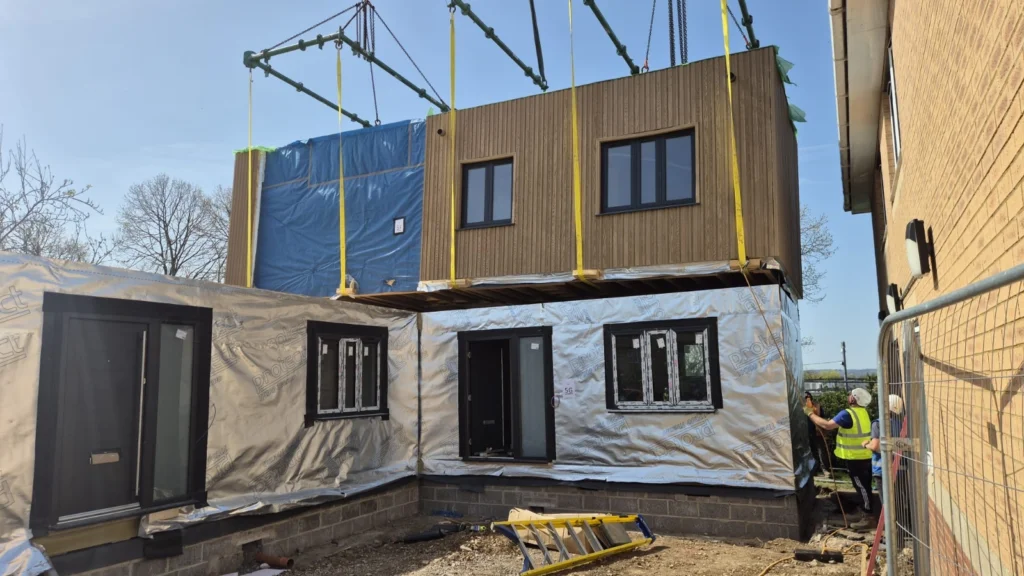
Places for People is calling on councils across England to unlock unused land for modular homes to help tackle the worsening homelessness crisis, instead of spending billions on emergency hotels and B&Bs.
Currently, £2.8billion is spent each year on temporary accommodation, while more than 134,000 households in England, including 176,000 children, are currently living in temporary accommodation. Costs are also expected to rise, with the Local Government Association forecasting that the annual total will rise to £4billion by 2030.
PfP says that money could instead be used to house people in purpose-built modular homes on unused council land, reducing temporary accommodation costs by approximately £24,500 per household, while giving families a stable, safe place to live much sooner.
To do this, PfP wants to work with councils to make suitable unused land available for development and is offering to work with them and the government to roll out nationally an approach it has already successfully trialled in Bristol.
Built off-site and installed in as little as 12 months, modular homes meet the same quality and environmental standards as traditional builds, and the construction process can be 30-50% faster. They can also be installed on small or underused plots of land, including disused car parks and other vacant council-owned sites.
PfP says, by adopting this approach, councils in England could help rapidly deliver affordable, quality homes for thousands of families reliant on temporary accommodation by bringing underused public land into use and redirecting temporary accommodation funding into housing people in modular housing.
In Bristol, the approach is already being put into practice. Places for People, working with Bristol City Council, has delivered 20 modular homes for people at risk of homelessness to date, with more nearing completion.
Based on its work to date in Bristol, PfP calculates that each modular home could save councils up to £24,540 on rents per household every year where an individual or family is moved from emergency hotel/B&B accommodation.
At Fortfield Road in Bristol, a new scheme of two-bedroom modular homes for vulnerable families is nearing completion. The homes, constructed by PfP’s own modular specialist, Modularwise, will offer stability for up to two years, alongside tailored support to help residents move into permanent housing.
In addition to providing residents with a private space and their own front door, schemes like this also integrate support services, connecting residents with healthcare, employment and other resources, which PfP is rarely possible in temporary accommodation. This includes a pathway into more permanent accommodation.
Larry Gold, CEO for housing and communities at PfP, said: “Temporary accommodation has become a national crisis, with hundreds of thousands of families - including 176,000 children - growing up in hotel rooms and B&Bs without the stability or space they need to thrive.”
“There is a clear opportunity and urgent need to do things differently, and we want to use our experience to help the government and councils end the homelessness and temporary accommodation crisis.”
“By investing in modular housing, we can not only reduce the enormous costs associated with temporary accommodation, but far more importantly, provide people with the safe, secure homes they deserve.”
“We must move beyond outdated perceptions of modular as a stopgap. These are high-quality, long-lasting homes that can play a central role in tackling both the immediate pressures of homelessness and the long-term housing shortage.”
“We are here and ready to work with the government and councils to do this. The funding is already there; we need to use it more effectively – supported by speeding up the planning process and unlocking unused public land.”
PfP is calling for:
- Leadership: PfP wants to work with councils across the country to prioritise development of modular housing for temporary/emergency accommodation, by unlocking unused public land, identifying sites for homes and redirecting money spent on hotels and B&Bs.
- Planning and regulation: Faster planning processes, including the introduction of fast-track approvals for modular developments; review of regulation to enable fast delivery.
- Skills: Investment in skills and training to grow the modular construction workforce.
- Funding: Reform of funding models to prioritise modern methods of construction in temporary accommodation provision.