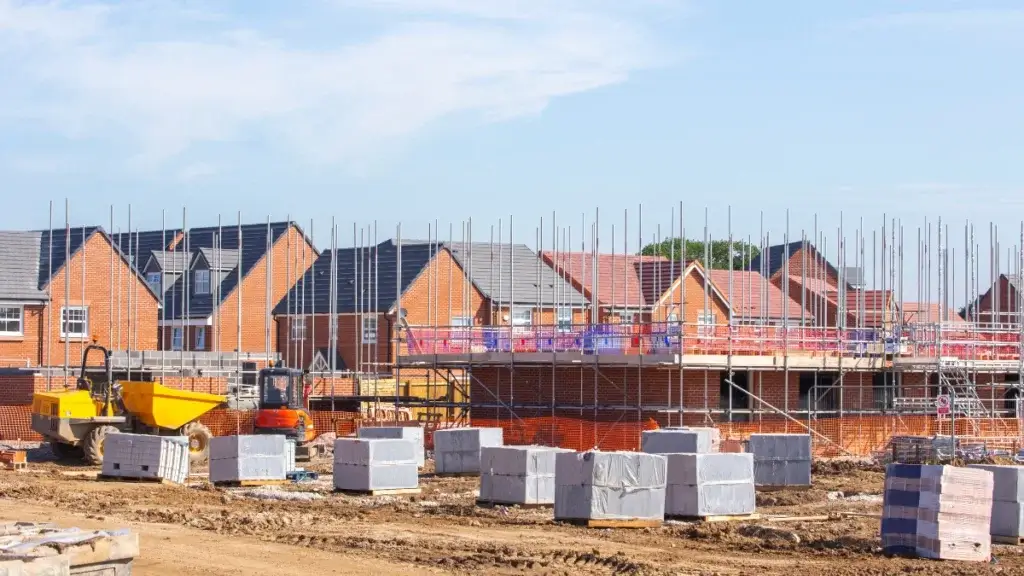
Glenigan, one of the construction industry’s leading insight and intelligence experts, has released its UK Construction Industry Forecast 2023-2025 and predicts growth in the housebuilding industry after more short-term challenges.
The November Forecast, which focuses on 2023-2025, outlines that the construction industry will continue to struggle in the face of a challenging economic climate. In particular, restrained private sector investment, a housing market slowdown, weak UK economic growth, and high interest rates will continue to suppress sector activity for the remainder of the year.
Despite short-term woes, renewed construction growth is forecast for 2024 (+8%) and 2025 (+7%) as the prospect of a recovering economy and market certainty lifts consumer and business confidence, boosting the industry.
This report is predominantly focused on underlying starts (< £100m in value), unless otherwise stated, and contains a comprehensive overview of the current state of the construction industry.
Sluggish economic conditions set to stall short-term growth
Construction starts have remained weak throughout 2023, with a poor economic outlook putting the brakes on work starting on-site. The fallout from last autumn’s mini-budget has weighed heavily on private sector activity, made worse by sharp interest rate rises in recent months.
The persistent economic disruption has prompted clients and developers to scale back on planned investments, causing detailed planning consents to fall back 10% during the first nine months of 2023. Main contract awards have also dipped, standing 11% lower during Q3 2023 than the same time a year ago.
Glenigan predicts a decline across most non-residential sectors during the rest of 2023, with project starts falling 20%.
Recovery on the horizon
It’s not all bad news, with public sector construction providing a relative bright spot during 2023 as government underspend was rolled forward to the current financial year, boosting departmental capital programmes.
Despite conditions remaining tough for the rest of 2023, gradual recovery is forecast for 2024 and 2025, with firm development pipelines already pulling through to support a rise in industrial and office starts. Improved consumer confidence and household spending are also expected to feed through to lift activity in consumer-related verticals, including private housing and retail. This is anticipated to have a knock-on effect on investment in logistics facilities from 2024 to meet demand for online retailing.
However, these positive predictions will likely be offset by declines in public sector investment in education and health as government-funded projects are reviewed post-election.
Tentative growth for private residential construction
Private housing market activity fell sharply during Q1 2023 as starts on-site softened thanks to economic uncertainty and inflated mortgage costs. Retrenched starts have continued throughout the year alongside further increases to the base interest rate. Faced with a slowdown in housing market activity and low house prices, the development pipeline has also been constricted by developers opting to build out existing sites over new projects.
While weak private housing starts are expected to continue throughout the rest of 2023, with Glenigan forecasting a 23% decline, housing market conditions will gradually improve. Better household incomes may cause buyers to take advantage of reasonable house prices, helping to support a partial recovery during 2024 (+4%) and 2025 (+11%) as housebuilders respond to improved consumer confidence and strengthening property transactions.
Glenigan’s economic director, Allan Wilen, said: “After sharp falls in starts and a challenging set of economic circumstances in 2023, construction can expect gradual improvement in market conditions over the next two years. Interest rates now appear to be at their peak, and a gradual easing in rates from 2024 should help to rebuild private investors’ and homebuyers’ confidence and lift private sector activity.”
“A sustained retrenchment in starts is forecast in 2023 as housebuilders respond to a slowdown in new house sales, choosing instead to focus on works to existing sites. Despite this, brighter economic prospects are expected to support strengthened property transactions and a modest project-starts recovery during 2024 and 2025.”