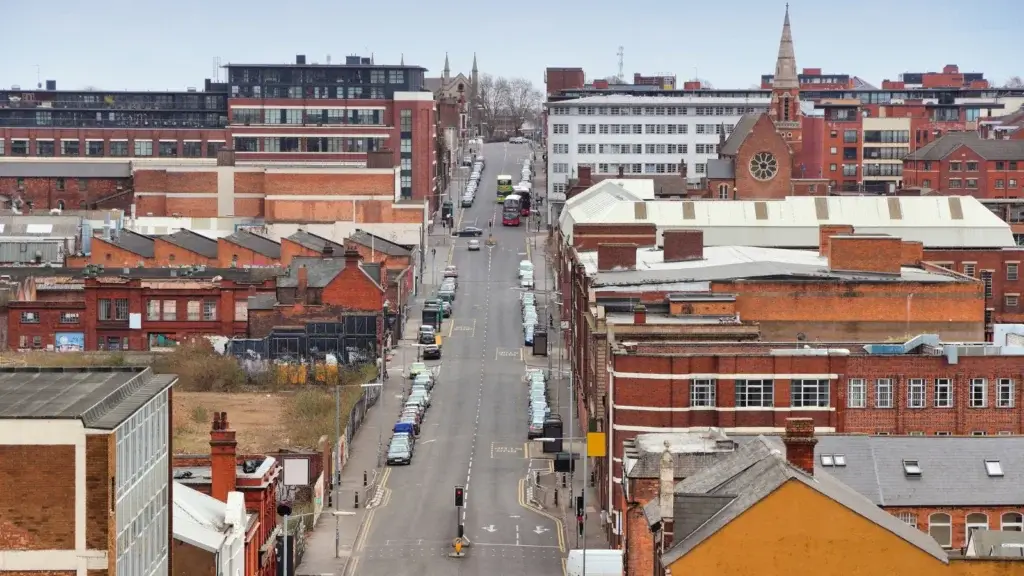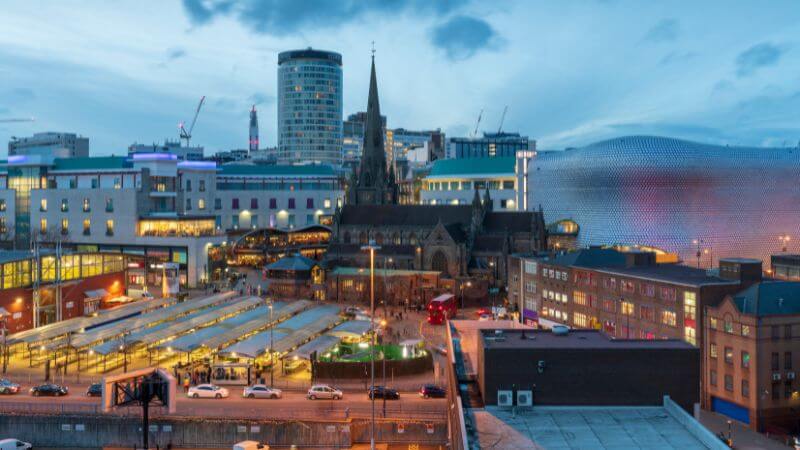
A new report from property consultant, Knight Frank, says that residential developers have a major opportunity to provide much-needed high-quality accommodation in Birmingham, a city that’s currently experiencing high demand and limited stock.
The latest data on new homes delivery shows that the city continues to fall short of current housing need. Recent Energy Performance Certificate (EPC) data, a forward indicator of housing supply, points to a decline in development in the first nine months of this year. Overall, the number of EPCs granted to new homes in the city fell by 5% compared with the same period in 2022 to just over 3,000.
This is 60% below the city’s annual housing target of 7,136 homes per year, using the government’s Standard Method of calculating housing need.
Birmingham currently has plans for a number of landmark, mixed-use schemes over the next decade. According to Knight Frank, there are currently 18,575 units across 85 schemes of at least 10 units with detailed plans granted in Birmingham. Of these, over half are schemes of 100+ units, while 13 are schemes of 500+. These major developments include New Monaco on Bristol Street, comprising 1,050 units; Upper Trinity Street, a mixed-use scheme with 943 apartments; and the 928-home Stone Yard scheme.
House prices in the city have slowed in 2023 from a recent peak in the 12 months to September 2022 to 3% this year to June, Knight Frank said. The pandemic period fuelled a ‘race for space’, leading to a rise in migration from London into Birmingham and boosting housing demand. This demand has since slowed but prices still outpace those in London.
The construction of the High Speed 2 rail link to London has certainly been a driver for both residential and commercial development in the city, paving the way for Blue Chip companies, such as Goldman Sachs and HSBC, to open new offices in Birmingham.
Recent data shows a significant increase in high earners moving from London to Birmingham with a 26% rise in the number of movers earning over £70,000 per year in 2022 compared to 2021 according to Experian. The overall growth of the city is expected to grow by 2% over the next ten years reaching 3.2 million by 2034 according to Oxford Economics.
The city’s economy is also growing, with Oxford Economics forecasting an increase of 16% in GVA over the next decade from £27.8billion to £31.8billion in 2033 – ahead of the 15% forecasted across the rest of the UK. Key growth areas are set to power the region’s economy as it moves away from its manufacturing heritage towards life sciences, tech and logistics.
Despite this growth, high inflation and elevated finance costs remain a considerable pressure on households and businesses. While housing affordability in Birmingham is less acute an issue than other areas of the UK, it remains a key focus.
Liam Smith, a partner and head of Birmingham New Homes at Knight Frank, said: “Although we have seen the rate of house price growth slow, prices are still outpacing those in London. Our investor and owner-occupier markets continue to see the merits of the Birmingham market, particularly with the investment being made into the city, predicted population growth and with this, demand for residential property.”
Anna Ward, an associate in Knight Frank’s Research team, said: “Despite there being a few months remaining of 2023, the fact that housing delivery is currently 60% below the city’s annual housing target is a stark reminder of the supply, demand imbalance in Birmingham. It is reassuring to see plenty of ambitious schemes in the pipeline which will also bring forward new commercial development and jobs, but this only underscores the need to build more homes as the city’s economy and workforce expands.”
Will Jordan, a partner and Head of Birmingham Residential Development at Knight Frank, said: “In the face of market challenges, Birmingham leads the way as one of the UK’s major regional cities, attracting forward-thinking developers and investors looking for opportunities within the build to rent and open sales markets.”
“With the increase in choosing to migrate to Birmingham from other parts of the UK, there is a huge opportunity to invest in the residential sector and meet soaring demand. There is so much untapped potential and it’s exciting to play a part in a city which is continuously evolving.”