 Craig Carson, managing director at Barratt West London, explains how breathing new life into the country’s forgotten buildings could provide much-needed housing without losing our history.
In the face of increasing pressure to build housing, many towns and cities are considering removing their historic buildings by demolishing them. There is a scarcity of ‘obvious’ construction sites left, so many are now looking toward brownfield or even greenbelt sites. Whilst the argument to protect the UK countryside is, of course, persuasive, 18% of these sites are described as neglected, derelict buildings and should ultimately be classified as brownfield. According to Unlatch, the number of available brownfield sites available in London could provide enough space for around 355,000 new homes. However, if we look closer, we can see that there are many hidden pockets of land – the forgotten historic buildings – just waiting for revitalisation.
People value the historic environment as it represents clues to our past and how our society has evolved; it gives distinctiveness, meaning and quality to an area and provides a sense of continuity and a source of identity, something that can be difficult to recreate in a completely new development.
Architecture
Retaining original architecture plays an important role in helping us to provide the homes and community facilities that an area needs, while still paying homage to what was once there before. Just look at our Upton Gardens scheme in Newham for an example of how a heritage asset – the old West Ham FC ground – has been successfully recognised through the placement of the tower gatehouses in the same position as the yellow turrets of the original football stadium entrance. In total, the site retains a similar mass to the stadium, while the pitch’s former centre circle is now a paved circular courtyard at the heart of the open space.
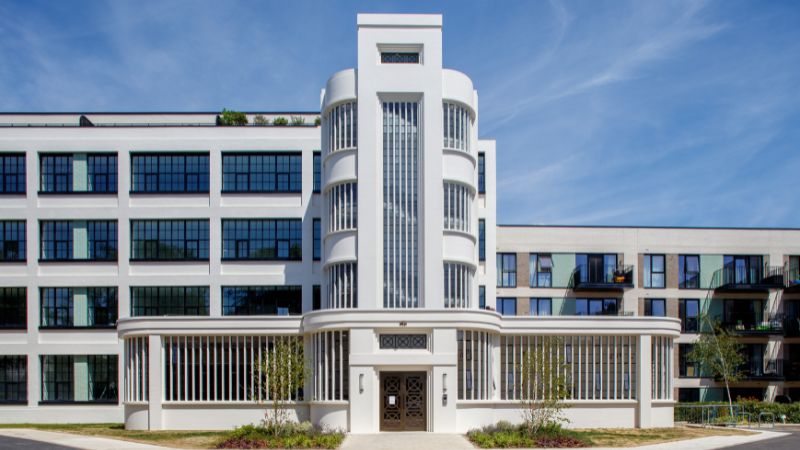
That said, the restoration of such an asset doesn’t have to be an extensive project to achieve maximum impact. At our Hayes Village and Eastman Village developments in West London, we’ve gone back to basics and focused on the superficial aspects of heritage. Each site was a former factory – the old Nestle chocolate factory and Kodak factory respectively. At Hayes, we’ve replicated the art-deco, crittall-style window frames, restored the 19th Century decorative gates and railings, and retained the original colonnade outside the building which will house a new community centre. At Eastman, we’ve restored the iconic Kodak factory chimney, and used traditional red industrial bricks, similar to the old factory, for the new buildings. We’ve also added subtle graphics in the signage and balcony screens linking with the site’s heritage.
In Croydon, we’ve gone a step further and transformed the landmark water tower at the former Cane Hill Hospital site into an impressive four-bedroom home.
More than bricks and mortar
However, it isn’t just about breathing life back into the bricks and mortar. Making heritage assets a focal point for development can go beyond the regeneration of buildings and places; it can bring together communities and can foster a sense of ownership that encourages repeat use. Something we’ve seen that is popular among first-time buyers and young professionals is that they want to be a part of something bigger. Using buildings to create homes and communal facilities like community centres, shops, cafes, sports centres and family play areas, not only injects life and vibrancy into these spaces but also encourages footfall into forgotten parts of towns and cities, kick-starting the permanent and sustainable development of the area.