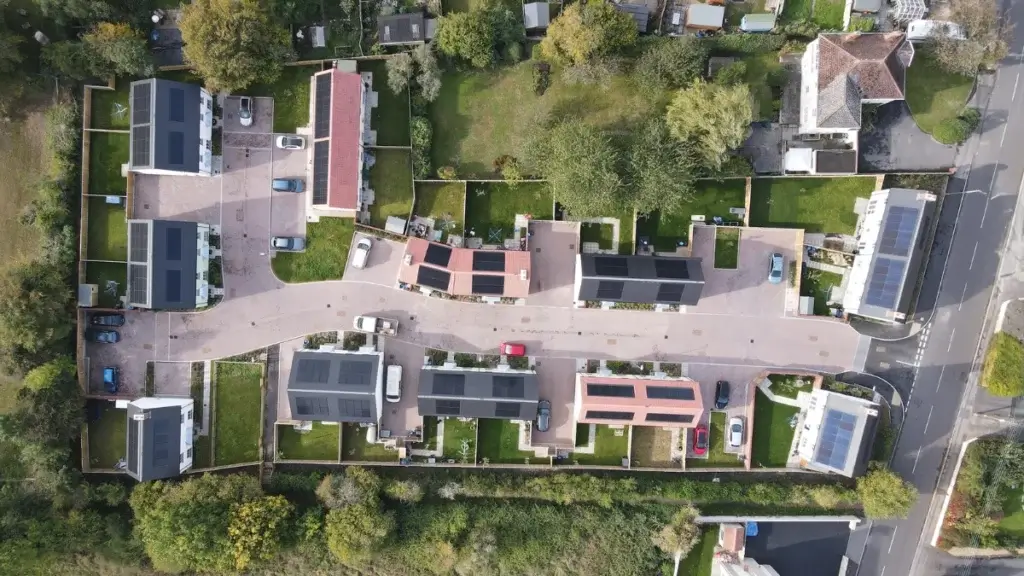
We’re all in it together as we walk the long and often arduous path to net zero homes. But is it housebuilders or their supply chain partners that are leading the way? Ginetta Vedrickas reports
And are we all really in it together? It was only last September that the government backtracked and announced a watered-down version of green targets for the country, with environmental groups pointing out its requirement to meet legal obligations to achieve net zero gas emissions by 2050. Despite the U-turn, the evidence is stacking up that the construction sector must act… and fast, as insight from the UN Environment Programme (UNEP) says that the sector accounts for a whopping 38% of all global carbon emissions.
Emma Brigginshaw, head of sustainability and ethics at myenergi, warns that the sector is increasingly under pressure to tackle its sustainability challenges, as well as meeting looming net-zero targets.
“While by no means the sole contributor to the construction sector’s carbon woes, housebuilding and property development is responsible for a sizeable percentage. What’s more, when you add operational emissions into the equation, its overall impact is significantly higher than most reports would suggest.”
Brigginshaw references industry expert Inger Andersen, executive director of UNEP, who says that a triple strategy is needed to deliver measurable change, comprising implementing material strategies that will reduce lifecycle carbon emissions, decarbonising the power sector, and reducing energy demand in the built environment. Brigginshaw warns that there’s no short-term fix.
“It requires challenging some of the industry’s most historic processes and practices, such as the incumbency of steel and concrete. Yet, the result of developing a low-carbon roadmap – and acting upon it – will accelerate real-world progress towards achieving net-zero ambitions and slowing climate change.”
Brigginshaw says that it’s now a priority for the entire supply chain, to not just meet their own targets, but also demonstrate their wider impact when it comes to decarbonising the sector, but adds that “housebuilders and property developers are pedalling hard to keep up.”

Myenergi is determined to help homeowners and businesses face the challenge: “By developing simple, yet powerful solutions to reduce reliance on grid supply and enable consumers to take control of their consumption, we’re enabling the transition from a traditional, national energy system to a far more decentralised, decarbonised, renewable landscape fit for the future,” explains Brigginshaw, pointing to its “ecosystem of eco-smart tech solutions” that helps users cut costs, optimise consumption and minimise reliance on the grid.
“From a housebuilding perspective, our technology can improve your SAP 10.2 score, contribute towards your build’s sustainability credentials and help you comply with the latest Part L, L1A, building regulations. From our zappi EV charger and eddi power diverter, to our modular battery storage system libbi, our priority is to give households greater energy independence, while setting the standards in sustainability.”
Brigginshaw accepts that her company’s contribution is a “small but important jigsaw piece in the UK’s net zero future” but myenergi walks the walk when it comes to its own sustainability practices.
In the last year it has achieved ISO 14001 certification and agreed a 100% renewable power contract with its energy supplier. Solar panels fitted at production facilities help to decarbonise manufacturing operations and power its electric vehicles.
“We’ve been working hard to put the foundations in place for our corporate sustainability strategy, and we’re pushing to make a measurable difference,” says Brigginshaw.
Warning that a 6% reduction annually is not easy and will require collaboration across the supply chain, she adds: “Housebuilders, property developers and the wider construction sector are facing a major task ahead to achieve their decarbonisation ambitions. We’re proud to be working alongside some of the UK’s leading housebuilders to help reduce energy demand in the built environment. There is no silver bullet solution to reach ambitious goals, so embracing the latest, and most effective, strategies to accelerate progress remains a key priority.”

With the residential property industry firmly in the spotlight, South East housebuilder, Elivia Homes, is embracing the challenge head-on. Backed by B Corp-accredited Octopus Investments, the company is determined to become a sustainability trailblazer in the sector.
Jitin Mitra, group head of strategy for Elivia Homes, explains: “The company recognises the opportunity to enhance the long-term sustainability of local communities and being environmentally conscious in design, build and legacy.”
This year marks the launch of Elivia’s ambitious sustainability roadmap. Grounded in enhancements to its house types that historically exceed regulation, the company says it utilises fabric-first principles to ensure homes are constructed to require less energy to heat; and then utilises the latest low and zero emissions technology to provide energy to them. This not only means a reduced carbon footprint for homes, but lower bills for its customers.
As an early adopter of MMC, with 74% of its homes currently in production using sustainable timber frames, Elivia has a track record of piloting innovative low- and zero-carbon technologies. Adopting air-source heat pumps (ASHPs) over 10 years ago, it is now scaling up through greater adoption of ASHPs, photovoltaic panels, wastewater heat recovery, and mechanical ventilation with heat recovery systems. All Elivia properties are rated EPC B or above, placing them among the top 12% of the UK’s housing stock, and its sustainability pilots, such as the Passivhaus homes delivered at its Hawkin’s Field development in Fittleworth, West Sussex, are part of an agile ‘test and learn’ strategy, in anticipation of the 2025 Future Homes Standard and future delivery of net zero homes.
Ashley Cooper, managing director at WMS Underfloor Heating, says that the industry is navigating the most significant legislative adjustments the UK housing market has ever seen, and it’s never been more critical for new-build heating systems to work in harmony and maximise efficiency.
“The government expects heat pumps to become the primary heating technology for new homes; however, for these renewable heat sources to work at their most efficient (COP) level, they must run between 35°C and 45°C. Hydronic, water-based, underfloor heating can easily achieve this by design. Still, all relevant suppliers must view the entire new-build heating system design holistically to ensure it delivers its promised efficiency levels.”

Cooper knows how daunting meeting new regulations can seem and promises that WMS’ mission is to support the industry in planning for a low-carbon future: “We believe knowledge is power, and with 20 years of specialist underfloor heating experience, we also have more than a decade of experience working with air-source heat pumps. In addition to offering product, design, and technical support, we responded to customer needs by launching our accredited Future of Heating CPD in 2021. We’re here for customers every step of the way.”
Cooper sees plenty of other benefits to underfloor heating. Traditional radiators are less efficient than underfloor heating and expected to last for just 25 years, and, once decommissioned, become a waste product in a relatively short space of time, whereas, Cooper says, underfloor heating systems can last three times longer, with at least a 75-year guarantee, providing additional reassurance that it will likely outlive the lifetime of the building.
Committed to reducing environmental impact and continually improving environmental performance as an integral and fundamental part of its business strategy and operating methods, WMS is working hard to reduce carbon footprint by lowering the environmental impact of components and systems as much as possible. It utilises smart software technology during installation programmes and precision planning to minimise journey times.
“We are constantly reviewing and investing in new ways to continuously improve our use of materials, installation technology and energy efficiency. This substantial investment has increased our operational agility and enabled us to explore new and exciting product stream opportunities,” adds Cooper.
It’s been a busy 12 months for Mitsubishi Electric. Last July, it celebrated 30 years of manufacturing at its Livingston factory, and, as part of the anniversary event, the five-millionth product came off the production line, the new Ecodan R290 heat pump. Less than a year later, it is opening the Livingston training centre for heat pump installers.
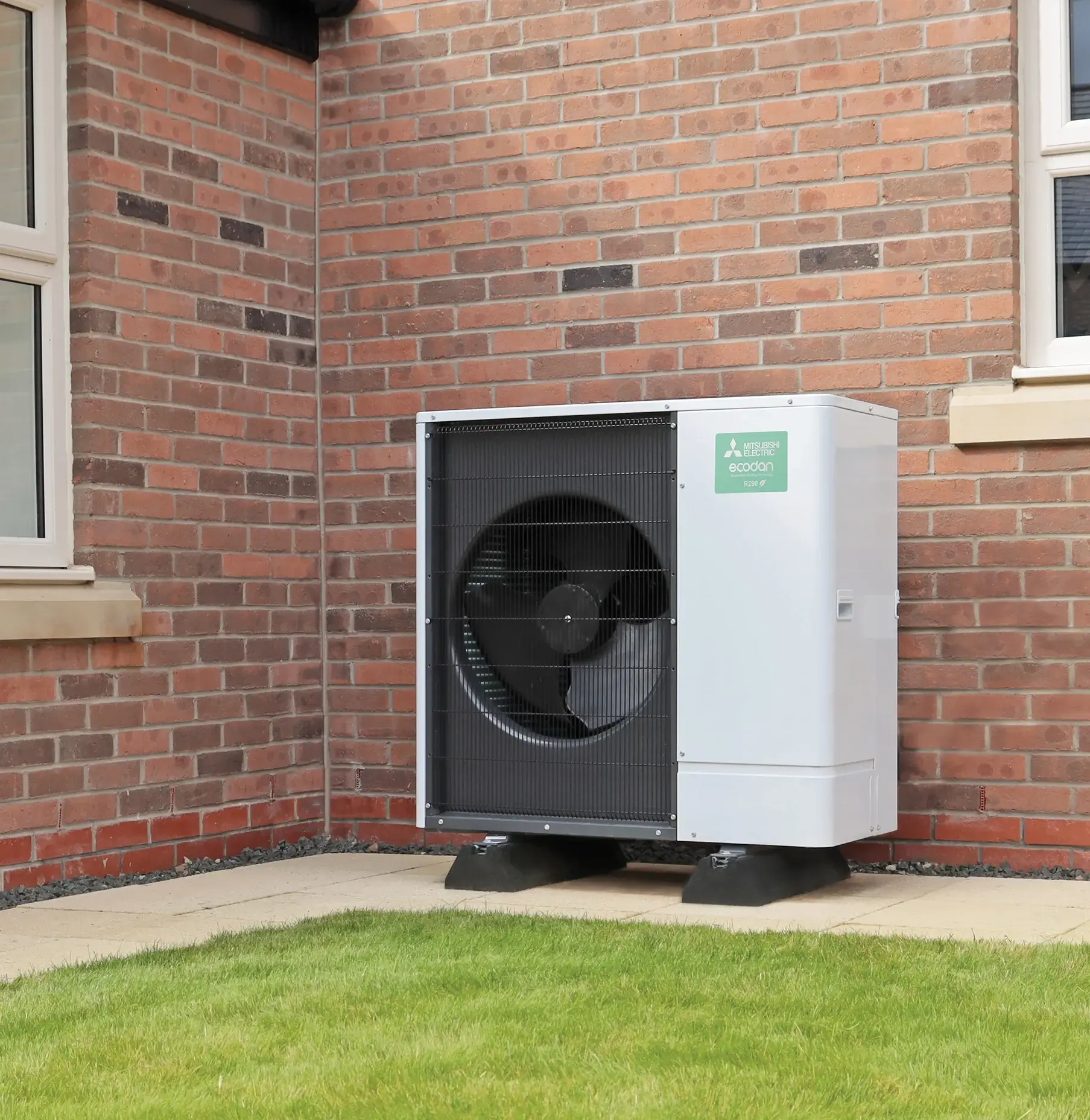
“Legislation and incentives are making heat pumps the de facto home heating and hot water system for homes. The government’s Future Homes Standard, for example, is moving developers to install heat pumps in new housing, and the Ecodan R290 is proving to be particularly attractive,” says communications manager Achilleas Georgiou, who says that heat pumps are widely recognised as one of the most effective technologies for decarbonising home heating, reducing greenhouse gas emissions, and helping the UK reach net zero. Even when it’s -25°C outside, the innovative Ecodan R290 can provide reliable home heating with temperatures of 65°C.
“That’s why Ecodan heat pumps are perfect for a housing developer looking to provide quality and home comforts for their projects that don’t cost the earth. We are proud to work with some of the largest and most successful housing developers in the country. We partner them on prestige, award-winning developments, whether that’s homes for private buyers or for social housing providers,” adds Georgiou.
Made in Britain, to British standards for British homes, Mitsubishi Electric is the UK’s largest manufacturer of renewable products and its Ecodan heat pumps undergo rigorous quality checks before being transported for installation across the country. Georgiou says that while decarbonising home heating is critical to reaching the government’s net zero target by 2050, to achieve that the government has a second target: to install 600,000 heat pumps every year by 2028.
“To reach this decisive target more heat pump installers must be trained. This is why Mitsubishi Electric is opening a training centre in Livingston, Scotland. This is part of a national plan adding to the training centre in Hatfield, Manchester, and other locations.”
Inevitably, there are cost barriers to net zero housebuilding but Wondrwall ESC (Energy Service Contracts) gives housebuilders the option to stay ahead of their competition by achieving their sustainability goals at no extra cost, attracting buyers with more energy-efficient and cheaper-to-run homes.

Daniel Burton, CEO of Wondrwall, explains: “Keeping the pressures facing housebuilders front of mind, the funded model of Wondrwall ESC is designed specifically to remove the cost barriers to net zero energy housebuilding. Savings that are made via energy bills allow Wondrwall to implement the ESC model.”
Without this model, housebuilders looking to create future-proofed, net zero homes might pass this cost on to buyers or swallow costs themselves. “The ultimate beneficiary of Wondrwall ESC, the homeowner, is the party absorbing the cost through their monthly service charge, a cost offset, and some through energy bill savings,” adds Burton.
Burton believes that, at a time when energy costs have fluctuated widely, providing a guarantee of reduced costs now, and in the future, is an asset to housebuilders selling in a competitive market. Wondrwall ESC gives them access to thousands of pounds worth of solar PV, battery storage and EV charging technology at no extra cost, keeping build costs down. Instead, the cost of the renewable technology is attached to the property with a fixed-price monthly service charge. The charge has no upfront fees for homeowner or housebuilder and includes maintenance, energy management services and free hardware upgrades long-term.
The company has spent the last 18 months working with stakeholders across the housing value chain to develop the funded model, enabling all new build homes to be net zero energy from build, without incremental costs to the housebuilder or homeowner. While homebuyers typically support playing a part in tackling climate change, financial constraints often trump all other factors, says Burton, so, hefty upfront costs to install renewable technology or homebuyer premiums to pay for them could result in dwindling consumer support: “We saw this in London’s response to ULEZ when it was first announced and the surprising local election results that followed.”
Redrow’s customer research reveals just how seriously today’s buyers take energy efficiency. Almost half of respondents cited it as a factor in their decision to buy, and having an energy-efficient home was found to be one of the key ways they felt they can influence the environment, second only to recycling.

Group sales director James Holmear says that Redrow has always been committed to futureproofing homes and communities by taking a customer-centric approach and constantly evolving designs and features in response to customer demands: “Our new generation Eco Electric homes, have a range of future-ready features, including air-source heat pumps, even thicker insulation and ground floor underfloor heating as standard.”
The housebuilder intends becoming an early adopter, with its commitment to achieving net zero greenhouse gas emissions. Working with the Carbon Trust, it has set near-term targets against a 2021 baseline, validated by the Science Based Targets initiative (SBTi). Its target is to achieve net zero carbon by 2045, submitted to the SBTi for verification, which will sit alongside its approved carbon reduction targets for 2030.
Redrow fully appreciates the value of supply chain partnerships in the road to net zero and has nurtured sustainable partnerships with suppliers that share its values. Having worked with Commercial, which supplies printing services, office supplies and interior supplies to Redrow’s divisional and head offices, for over 20 years, Redrow’s head of procurement, Steve Horridge, believes that its business can only be truly sustainable if it works with suppliers who share its environmental aspirations, standards of responsibility and ethical conduct.
“Our supply chain policy is in place to ensure we procure materials from responsible suppliers and remain on track with our net zero carbon strategy, as well as laying out how we support our supply chain to achieve their own goals; for example, through our partnership with Supply Chain Sustainability School,” says Horridge.
Newland Homes launched its first zero carbon home in North Somerset in 2022 and the housebuilder now has around 200 zero carbon homes underway or in the pipeline across the south-west, including affordable properties for those most at risk of fuel poverty. The climate-considerate housebuilder recently announced a groundbreaking achievement in its commitment to sustainability: a substantial 49.21% reduction in operational carbon emissions over the course of a year.

Four upcoming developments, launching this year, will provide zero carbon homes, including bungalows, enabling environmentally conscious homeowners to ditch fossil fuels and harness the power of renewable energy. By jettisoning gas boilers in favour of ASHPs, increasing the quality and specification of solar panels, and upping insulation levels, these zero carbon homes create as much prime energy as they need, says the housebuilder, which has achieved premium market values at 10-20% above traditional new build houses in the same area. Homeowners at its first zero carbon scheme, Ryves Vale in Tickenham, reported a weekly cost of £3.57 in summer months to power a four-bedroom detached, zero carbon home. 80% of Newland Homes’ car fleet is now fully electric with more initiatives in the pipeline to cut the company’s carbon footprint.
“As a private company deeply committed to environmental stewardship, we recognise that reducing carbon emissions isn’t just a responsibility, it’s an imperative. Every tonne of CO² we emit contributes to the global climate crisis. By actively taking measures to reduce our carbon footprint, we set a positive example for our industry and inspire others to join us in building a greener, more resilient future for all,” says corporate services director, Tim Sergeant.
GTC has designed and developed a Future Homes Standard-ready heating solution for housing developments that will deliver a net-zero-carbon future for new homes: the Community Heat Hub. The Hub is an efficient, net-zero-ready heat network solution that can be utilised across low-density, new-build housing and mixed-use developments.

The first of its kind in the UK, it provides a commercially viable solution that can be competitively deployed on schemes of over 150 homes. Reducing carbon emissions by 75-80% from day one, the Hub uses large-scale heat pumps and thermal stores, housed within a centralised location, to generate low-carbon heat that is distributed throughout a network of insulated pipes to provide heat and hot water to homes. Its large hot water tanks allow it to generate and store energy as heat when electricity prices are low, allowing it to provide heat during peak times in the morning, without running any heat pumps. This flexible operation reduces the cost of generating heat, which keeps bills low for homeowners, and flexible use of hot water tanks and heat pumps will also reduce grid connection capacity, which is key as more heat pumps and renewables are connected to the grid.
GTC’s first Hub went live last month, at Westland Heath, in Sudbury, Suffolk and chief operating officer, John Marsh, is delighted to have worked with Taylor Wimpey to deliver a heat solution that meets the requirements of the Future Homes Standard, saying: “At build out, we will deliver heat and hot water to 950 homes.”
GTC has several other contracted sites where it’s delivering this solution and, based on current contracts, the Hubs will soon serve over 7,000 UK homes, as they are cost competitive against the alternative of separate ASHPs, offering housebuilders and homeowners savings of up to 20%.
As to whether the supply chain or housebuilders are leading the way to achieving net zero, Marsh says: “This is a significant point in relation to the Community Heat Hub because it provides a completely different supply chain in comparison to fitting individual air-source heat pumps in homes. The Community Heat Hub still uses air-source heat pumps but only a few at a very large scale. These are housed in a centralised location and will serve heat and hot water to over 150 homes at any given time.”
One of the best ways that heating companies can support housebuilders is to ensure their products fit seamlessly into the build process, explains David Broom, managing director of Kensa Contracting: “With that in mind, we’ve developed the Networked Ground Source Heat Pump model,
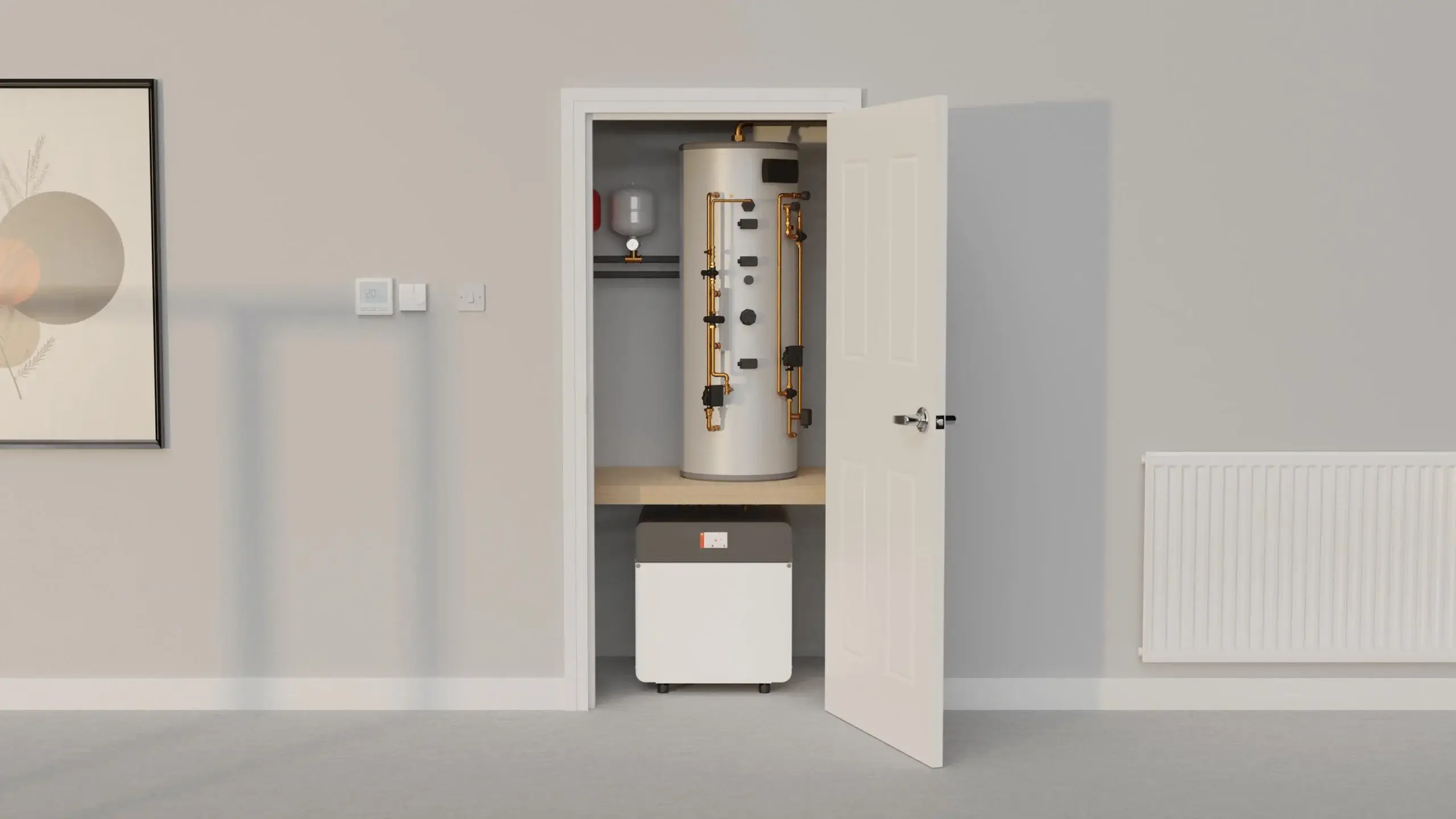
a 21st-century heating solution that will fit Future Homes Standard requirements and can be implemented as part of the utility installation process.”
Broom says that these types of pumps are already familiar to housebuilders and homeowners – the system provides energy to the home via infrastructure in the ground, which is converted into heating and hot water through a white box in the home without burning fossil fuels – but installation costs have been prohibitive.
“To tackle this, Kensa introduced a funding model that removes the upfront cost for developers. Like with gas, a private utility company completes and owns the underground network of boreholes and pipes, and those with a connection pay a standing charge to connect their heat pump.”
He sees multiple benefits for homeowners: “Ground-source heat pumps are the most efficient of the renewable alternatives and, therefore, provide the lowest possible running costs. Compared to individual air-source heat pumps, homeowners get to retain that extra outside space and, as they’re stored inside, the heat pumps have an expected 20-25-year lifespan, providing low lifetime cost of ownership.”
Broom adds that product innovation is also key to delivering green heating solutions, and, to make it work, manufacturers need to produce space-saving units that can still deliver a home’s heating and hot water needs. “We applied this when developing our Shoebox NX heat pump – a unit small enough to fit in a cupboard, simple to install, and capable of heating anything from a flat to a five-bedroom home.”
Brick manufacturer, Michelmersh, is proud to have played its part in the push towards sustainability.

Innovation director, Sarah Le Gresley, says: “I think the most pertinent point to report on, is that in our annual report published this month [April] we announced a 24.24% carbon reduction intensity, per tonne of product, which is a fantastic achievement.”
Its product, Hybrick, is the world’s first trial of 100% hydrogen powered bricks, which showed that it is technically possible to fire bricks using hydrogen. All three hydrogen trials were successful and achieved reductions in gas carbon emissions of 80-84%.
Despite this success, Le Gresley isn’t complacent: “We all need to collaborate to achieve net zero and a vast amount of technologies or fuel switching isn’t yet available for us to achieve our goals necessarily within this decade, but, as you can see, we are making vast strides.”
Find this article and plenty more in-depth news and insight in the latest Show House magazine here