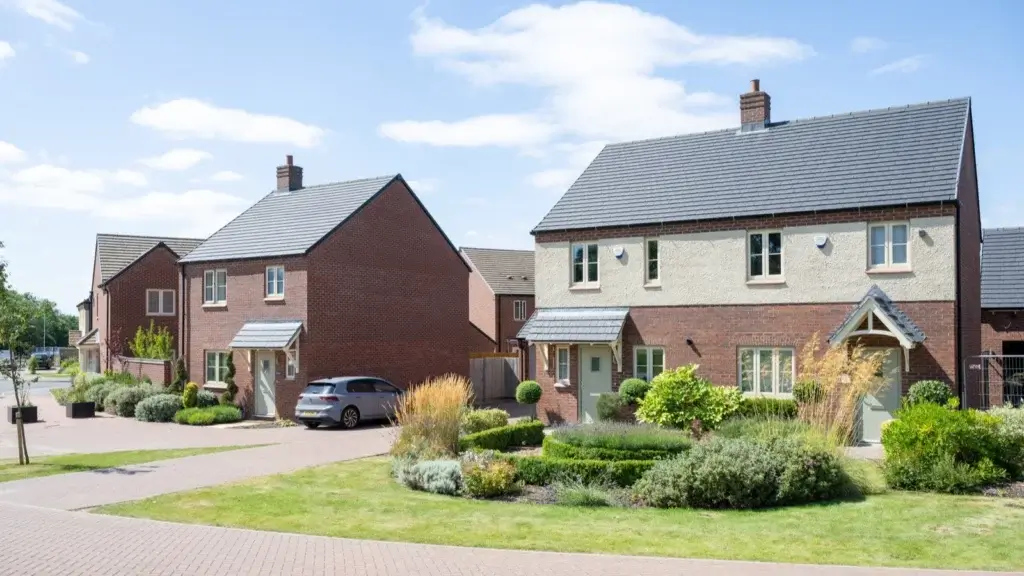
SME stands for Small and Medium-sized Enterprise. Such a bland abbreviation does scant justice to its cohort, especially when it comes to the business of housebuilding.
We love to divide this industry into volume players and SMEs and, unwittingly, can end up pitting them against each other.
Cliché says big means fat cats building for the shareholders not the community, vast amorphous estates swamping the countryside – quantity over quality. Meanwhile, the SME is seen as plucky and put upon, fighting against impossible odds to build small schemes of local character and integrity.
The volume players want big sites and that would serve the government’s purpose very well, as Labour trumpets its ridiculous boast of 1.5m new homes in the five years of this parliament.
One and a half million divided by a series of 10s, 20s, 50s and 100s is seen as too time-consuming. To Labour, and, let’s face it, any government, it is only important what happens, or is seen to happen, in five years, despite it being obvious to everybody that the only way the housing crisis can be solved is a 20-year project and minimal political intervention. I think the technical term you’re looking for is fat chance, or, in your dreams.
In truth, it is a mix of all of the above, and we need to start by exploding stereotypes and building a case for the very best of British housebuilding, whether as a business you construct 10 or 10,000 homes a year.
Of course, there is a massive difference in how such companies operate and their economies of scale, and spheres of influence. Any plc, housebuilder or otherwise, naturally has to consider its shareholders, but there are plenty examples of vast, visionary regeneration schemes of vaulting ambition, pleasing to both the eye and the balance sheet. Big can be beautiful; we just need to ensure that its shadow doesn’t blot out the sun for SMEs.
May’s Show House magazine is all about SMEs, and our supplement is a reminder of the quality and class the industry has out there – and, yes, it is tough, bloody tough.
When I asked a selection – and we’d be delighted to hear from anyone at any time – about their ‘hopes’ and ‘fears,’ I assumed the simplest answers would be ‘forlorn’ and ‘many’ respectively.
I think you can guess the fears. Planning delays and inconsistencies, the availability and price of land, rising build costs and supply chain volatility, domestic and global politics, skills shortages, regulatory and compliance burdens, and access to finance – to name a few.
There are worries about ‘where the next generation of SMEs is coming from’ and that the ‘failure by consecutive governments to protect our industry raise concerns for future viability’, while another lament is the potential loss of those builders ‘who know the name of the stonecutter or the joiner they work with’.
While all these are huge barriers that need to be overcome, it is the ‘hopes’ that give you hope and remind you just what a driven, passionate, principled industry we work in, but whose virtues we’ve singularly failed to ‘sell’ to the wider public.
The SMEs quoted talked of hope rooted ‘in the strength of our product’, craftsmanship and character, strength of both purpose and place; the future being not just about building more but building better. It is about treating uncertainty ‘not as a barrier, but an opportunity to innovate, refine and emerge stronger’.
Hope comes from the strength that the best SMEs have in their connection to their communities and ‘creating homes that respond to local context and offer a more personal buying experience’.
Show House celebrates its 30th birthday this month. I would hate to have filled these pages with a roll call of those SME developers around when we launched in 1995, no longer building and having gone to the wall in the past three decades.
Some casualties are through every fault of their own; bad businesses fail. But how many industries are subjected to so many hurdles to clear before they can even get their product on the pitch, in the aisle?
Some of the hurdles, given the size of the investment and how housing impacts on so much of the infrastructure, both physical and social, around it, absolutely must be there. But many are the result of a bureaucratic system Kafka would have struggled to fictionalise, in one of very few industries artificially deprived of its basic raw material – permissioned land. And even when it has that raw material, you are nowhere near being allowed to put a spade in it. For every hurdle cleared, another is put up – Whack A Mole meets Tom & Jerry meets Sisyphus.
Perhaps when Show House raises its bat to its pavilion of supporters to acknowledge its 50, the housing crisis might be sorted. Oh, for a 20-year, apolitical plan. If it does miraculously happen, let me know. I’ll be in the nursing home watching the cricket.
This article was first featured in Show House Magazine. Read more like this and the latest industry insight here.