John Marsh, COO at multi-utility network provider, GTC, looks forward to what the New Year will hold for housebuilders and their transition to renewable energy solutions.
The New Year always brings with it a renewed sense of focus and an element of retrospect for the year that has passed.
As we look ahead to what’s in store for the housing industry in the next 12 months, we can also look back and appreciate how far the sector has come in terms of heat delivery during 2024.
The Future Homes Standard is set to be commented on by the government imminently, which will mean that new standards will soon become mandatory for the sector. A huge success of 2024 was that many of the UK’s leading housebuilders haven’t waited for compulsory standards to be set, instead, they have taken decisive action in tackling carbon emissions on their housing schemes and already contracted renewable energy solutions.
We can all agree that this transition is essential, not least because the UK housing sector is a major contributor to carbon emissions, and the residential sector alone is responsible for around 20%. The numbers are stark but the country’s effort to circumnavigate from carbonised towards decarbonised heating systems is well underway, supporting the government’s 2050 net zero target.
As the end of gas approaches, the renewable’s playing field has opened right up and heat networks stand to play a pivotal role in how low-carbon heat and hot water can be delivered into UK homes, at pace and at scale.
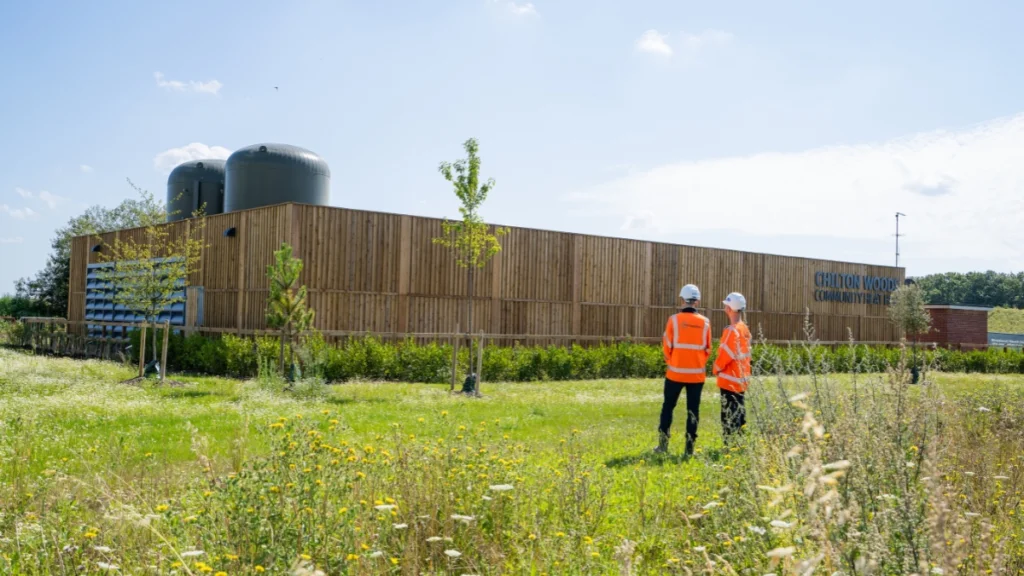
Heat networks have long been utilised across the globe. In the UK, heat networks have predominantly been installed across high-rise, high-density schemes, but in the last year, a heat network solution designed for low-rise, low-density schemes has been developed. It uses the same tried and tested technology and is now being rolled out across the country with several of the UK’s largest housebuilders on new build sites.
Community Heat Hubs use large scale air source heat pumps and thermal stores to produce hot water in the site’s central Heat Hub. Heat and hot water are delivered into homes through a site network of insulated pipes. Community Heat Hubs remove the need for individual air source heat pumps to be mounted outside every home and crucially they:
- Meet Future Homes Standard, reducing carbon emissions by 75-80% from day one
- Help address grid capacity issues, using the thermal stores to flatten the site’s grid demand. This significantly lowers a site’s overall peak demand compared with individual air source heat pumps
- Lower cost for housebuilders and lower customer bills by up to 20%, compared to individual air source heat pumps
- Will be regulated by OFGEM from 2025 giving homeowners the ultimate protection on price and service levels for their heat and hot water
In a bid to accelerate heat network rollout, it is vital that housebuilders are offered choice. Community Heat Hubs are one option. Networked Ground Source Heat Pumps, also launched this year for new build sites, are another option.
Networked Ground Source Heat Pumps work by extracting naturally occurring, stored thermal energy from the ground to provide consistent, energy-efficient heating.
The solution offers a clean alternative to gas through a ground source heat pump installed within each property, which is connected to a shared network of hidden underground pipes. The small, compact heat pump sits underneath a water cylinder inside the home, saving valuable space and eliminating the need for any external kit.
Networked Ground Source Heat Pumps can:
- Bring a complete end-to-end heating, hot water and cooling solution. This inclusion of passive cooling helps Part L Building Regulation compliance
- Reduce carbon emissions by 70% compared to conventional heating systems
- Offer up to five times the efficiency of gas and a 30% increased efficiency than an equivalent individual air source heat pump
Transitioning away from carbonised heating is essential, but the rise of renewable technologies brings with it a range of challenges for the industry – primarily the sheer number of options that are becoming available. Never has industry experience been a more important consideration for housebuilders looking for energy-efficient, renewable and future-proofed solutions to deliver heat and hot water into their new build sites.
The unified goal of the utilities industry is to support housebuilders with solutions that meet Future Homes Standards and help the UK achieve its net zero targets, at pace and at scale. Is there a one-size-fits-all answer for housebuilders as we start the New Year? No. There are multiple options and different developments and schemes will carry different requirements.
This is where solutions like Community Heat Hubs and Networked Ground Source Heat Pumps come into play because they are tried and tested and backed by innovation, skills and experience. These pragmatic heat network solutions are designed, built, owned, operated and maintained by the regulated utility infrastructure partner, offering housebuilders and consumers the ultimate simplicity.