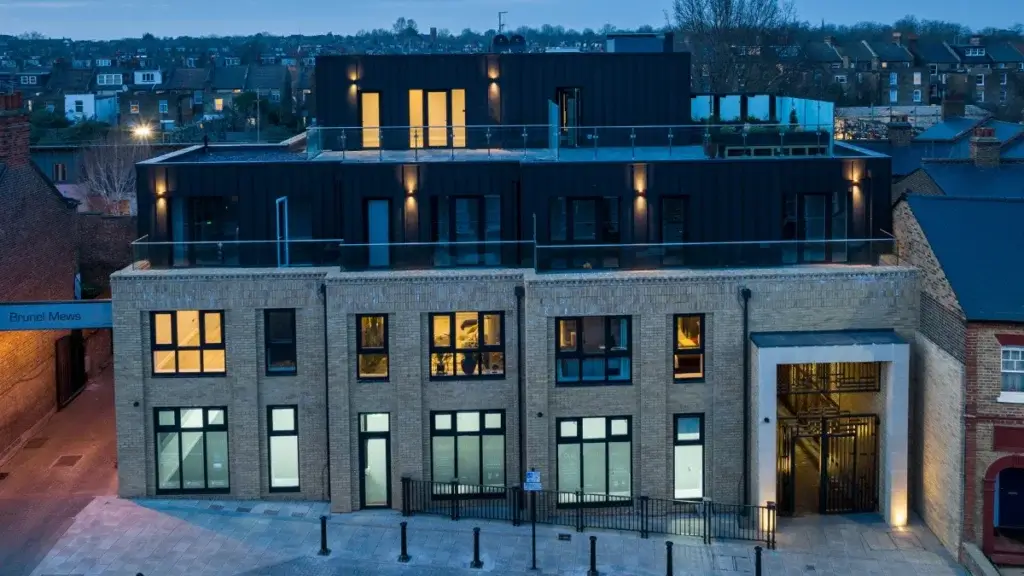
Mani Khiroya, CEO of Fruition Properties, looks at the rise and fall of airspace development, and what needs to be done to rebuild the model.
An easy way to gauge the health of London’s housing market is to count the cranes across its skyline. These once-ubiquitous silhouettes have long served as a barometer for the capital’s construction activity. Today, their decline speaks volumes. Recent Molior data enumerates this trend, finding that only 2,158 private homes began construction in the first half of 2025, a new low in a decline since 2023, and just 4.9% of the government’s half-year target.
Over the past half-decade, UK property development, and airspace projects in particular, have faced a confluence of pressures unlike any period in recent memory. Rising costs, shifting regulation, and shaken investor confidence have combined to stall or derail schemes that once defined urban innovation. The pre-pandemic promise of up to 41,000 new homes through airspace development now rings hollow. But understanding why this promising model faltered is the first step towards rebuilding it.
The rise of airspace
2019 promised a lot for airspace development in London. The revised National Planning Policy Framework urged local authorities to “support opportunities to use the airspace above existing residential and commercial premises for new homes”. Meanwhile, airspace projects across London were drawing increasing investor interest: Apex Airspace secured £10million from the Greater London Authority; Fruition Properties too, equipped with pre-existing expertise, were pursuing an expanding pipeline of projects in Putney, Bermondsey, and Westminster.
The sector was rapidly emerging as an innovative and fast-growing area within residential property. By building upwards, developers could extract value through the ‘air-rights’ above existing structures without facing the escalating costs of land acquisition. In high-demand cities like London, this approach offered a sustainable, low-disruption means of boosting housing supply while rejuvenating existing stock. Further, airspace schemes required relatively modest upfront investment, and many freeholders were eager to participate – viewing it not only as a creative investment opportunity but also as a way to upgrade the existing building’s fire safety or fund cladding remediation.
The regulatory transition
The Building Safety Act (BSA), implemented in 2022, hardly needs another introduction. Yet the familiar slow and arduous refrain continues, with developers still waiting an average of 36 weeks to secure Gateway 2 approval, triple the original 12-week target.
Two core issues are evident under the new regime. The first is a lack of clarity. Under the previous system, developers could collaborate with engineers and inspectors to ensure technical compliance before submission. Under the Building Safety Regulator (BSR), this consultation process has been largely removed, leaving developers uncertain whether their designs meet the required standards prior to review. As of 2025, around 75% of applications have been rejected for ‘missing or flawed information’.
The second issue lies in the major changes to fire regulation. Guidance has moved from flexible, performance-based requirements to highly prescriptive rules, with little distinction between new builds and regeneration projects. This rigidity has created practical barriers – for example, all but proscribing New York-style fire escapes – even in cases where buildings could demonstrably meet functional safety standards through alternative design solutions.
Even the BSR themselves have acknowledged the turbulence of this transition. Tim Galloway, the regulator’s Deputy Director, recently conceded to having “underestimated” the difficulty for firms and cited a lack of “deep construction industry experience” for the legislative and practical confusion.
But the damage, in many ways, has already been done. Projects that once symbolised innovation have stalled, investors have retreated, and confidence in the system has been shaken.
Broader headwinds
Well-intentioned but poorly planned legislation is evident elsewhere too, such as the mandatory 10% biodiversity uplift introduced last year under the Environment Act 2021. Amid economic uncertainty, these regulatory pressures are compounding existing market challenges. Rising costs combined with a shrinking labour supply and pandemic-driven productivity declines are squeezing the entire industry. Contractor insolvencies, interest rate-prompted investor retreat, and limited government support for buyers have further intensified the strain.
And London’s SMEs, a sector which has experienced a 66% decline in London over the past two decades, are perhaps bearing the brunt of this ‘perfect storm’, with 92% expressing dissatisfaction with the government’s approach to housing.
Silver linings
Airspace development remains innovative, sustainable and critical to addressing London’s housing shortage. Space scarcity and rising land costs ensure airspace could become a key tool in meeting demand – but success depends on dismantling rigid barriers, protecting SMEs and clarifying policy uncertainty.
Adapting existing regulations is essential to restoring confidence. Allowing alternative approaches to building safety and fire compliance – perhaps grounded in a risk-based framework – could achieve the same functional objectives without stalling promising developments. Moreover, distinguishing between new-build and regeneration projects is vital, with the latter often delivering additional benefits for the host building’s safety and sustainability.
Though the picture is challenging, no problem can be solved without first being acknowledged. By confronting these structural realities, the industry can adapt and begin to rebuild on firmer, clearer ground. In doing so, London’s property market may slowly start growing again, heralded by a new wave of cranes adorning the city’s skyline.