Life-threatening temperatures over 50°C were registered around the globe this summer, ensuring climate change and sustainability remain at the top of the agenda. The new build sector, in particular, is putting pressure on suppliers to demonstrate whole of lifecycle impact and circular design principles. Louise Walters, commercial director for Designer Contracts, the UK’s largest flooring contractor, looks at what it means for the flooring industry.
The world has witnessed previously unseen temperature extremes this summer, reminding us yet again that it is incumbent upon each and every one of us to tackle climate change at company level. To do what we can individually to ensure that as an industry, our collective efforts add up to meaningful effect.
New homes and buildings in England will have to produce significantly less CO2 under new rules announced by the government to help the country move towards net zero. The World Green Building Council has said that all construction must be operationally carbon neutral and create at least 40 % less embodied carbon by 2030.
The built environment accounts for 40% of the UK’s carbon footprint, 28% of which comes from operational emissions and 11% from materials and construction. Achieving net zero will certainly require a step change in the design of new buildings. Developers want to reduce scope 3 emissions, which flooring falls into, by 24%, so they are under huge pressure to meet these targets and are appealing to all their suppliers to help them to achieve this.
Developers are looking at their supply chain to share information and data with them, not only in terms of their own carbon performance but specifically at gathering information on procurement standards, materials selection, product design and the manufacturing process.
They want full transparency across their supply chain and have told suppliers that they can expect more detailed requests for data and supporting information such as product certification. There will be an increased focus on whole lifecycle impact and circular design principles, and they are widening the scope of sourcing transparency standards with a focus on minimising the environmental impact of the materials used within their supply chain.
Developers are, or will be, appealing to their suppliers to provide Environmental Product Declarations (EPDs). Although, as a contractor, we are not responsible for creating EPDs, we have been gathering both these and other sustainability information on the flooring products we install over the past 18 months. When specifying products, we regularly have conversations with our own suppliers about improving the recyclability element.
Our mutual customers are looking to us to help them make greener choices when it comes to flooring, and we need to think about how we can do this collectively. If carpet is to remain a staple when it comes to flooring within houses, ensuring it is sustainable is vital to achieving this.
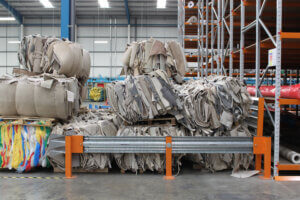 Designer Contracts is now working with Innovate Recycle, a recycling company which has invested heavily in state-of-the-art machinery and technology to develop a circular solution, producing plastic pellets from carpet waste for the plastics industry. According to Innovate, more than 500,000 tonnes of end-of-life carpet is produced in the UK each year, and for the first time there is a way, at volume, to deconstruct carpet and enable the reuse of its constituent materials in a wide range of industrial supply chains.
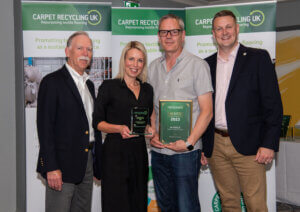
We have high hopes that our partnership with Innovate will ultimately enable us to further improve our long-established carpet recycling scheme for which – and for the sixth time since 2015 – we’ve been named Takeback Partner of the Year in the CRUK 2023 awards.
 The scheme has evolved significantly since we introduced it in 2015 and we now have a robust system that operates across our national regional network of 14 warehouses. We have become smarter in the way that we collect and return our waste to our central distribution centre by investing in balers and partnering with recyclers that can offer us a viable and long-term solution for the waste that is generated.
It is all part of our drive for circularity, which is key for us all – making high-performance products which can be recycled effectively. And the ability to incorporate recycled material into new products is vital to achieving that.
In terms of circularity, a lot can be learned from France which leads the world in end-of-life (EOL) recycling. It is currently setting up a system for recovering all building materials – including flooring – in line with the principles of Extended Producer Responsibility. Manufacturers are responsible for making sure their products are collected and recycled at end of life, with a tax in place to fund the EOL collection. It will be interesting to see the impact that has – and whether Britain itself will eventually follow suit.
To help developers make their decisions more easily, we have recently updated our features and benefits sheets to show how the products we supply impact the environment. Any sustainable elements of the product are now highlighted, including whether the product has a certified EPD and any other green feature. We can provide information on the percentage of recycled content, if the product is made in the UK, manufactured using low VOCs, as well as many other green credentials.
We all need to work towards better EOL outcomes, and it is heartening to see the changes already happening. A growing number of flooring manufacturers are looking at using or increasing the recycled content in their products with some great innovative products being developed.
This summer has quite literally turned up the heat on us all to consider how we can reduce the impact of climate change. And although floorcoverings constitute just one small part of a very big picture, we all have our part to play.