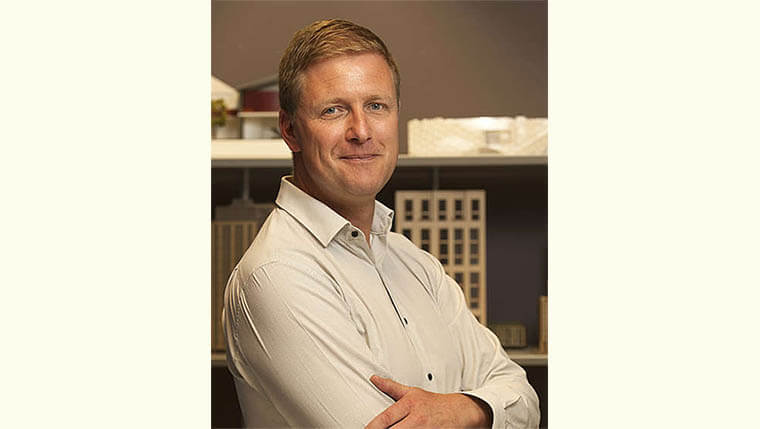
We speak to Andrew Mellor, partner at PRP, who tells us about his career in architecture, his commitment to improving the quality of buildings across the construction industry and what he loves most about his role.
Andrew, how did you know that architecture was for you?
I have had an interest in how things are built for as long as I can remember, so I knew I wanted to be an architect from a young age – well it was that or a policeman, but I think many young boys consider that idea!
Can you tell us how you started on your career path?
As I already had a clear idea of what I wanted to do, when I reached sixth form leaving age I searched for architecture courses with a technical focus and ultimately selected De Montfort University, which is where I completed the seven-year architectural education. After receiving my qualification, I joined a London practice whose focus was to become very much on sustainability, however at a time when it was not a topic on everyone’s agenda. It was here that I developed my passion for technical architecture and really found my own niche. I grew and learned a lot in my first role, getting involved with the delivery of sustainable office buildings. I also co-founded the practices’ dedicated sustainability group – which is still running today.
You mentioned a passion for technical architecture, how does this differ from standard design?
My strengths are commercially and technically focused as opposed to design flair, as such I am always looking for an opportunity to improve design detail and construction techniques and processes, in order to create better buildings that people truly enjoy living and working in.
I have a very strong understanding of how building elements work together, and the components required to create a successful and often innovative process. The difference therefore, is that my role isn’t necessarily to design a beautiful building but to contribute to the delivery or operation of a building that functions well. As such, I tend to be involved in the delivery of projects as well as the development of processes and products that contribute to successful buildings. This can include everything from design and technical solutions, cost and BIM management, to energy, sustainability and health and wellbeing consultancy. I also lead PRP’s research team which works with public and private clients to create new legislation and policy, innovative construction products, delivery processes and technical solutions both in the UK and internationally.
How have you helped PRP grow?
My appointment to the PRP team was initially part of a strategic effort to bolster its sustainability offering and position PRP as a leader in the sector. I’ve been with the firm for over 14 years now and during that time I’ve witnessed a real change in attitude towards the significance of sustainability, which is now taken very seriously. I have been described as an entrepreneur, someone who responds to market conditions and anticipates change to offer consultancy services that add real value to client’s development and asset management programmes.
Using my expertise, I am leading the practices’ Development Consultancy which aims to support clients to deliver and operate high-quality buildings. The sustainability team began its journey as a working group of architects with an interest in the environmental side of design, we then added engineers into the mix and very quickly it grew into an official service within PRP’s offering. The research offering followed five or six years later. The Development Consultancy was established in 2017 and integrated PRP’s existing project services team with the sustainability and research team, the Development Consultancy team now offer a very wide range of holistic services which continue to grow.
We made the decision to establish the Development Consultancy team to enable us to support clients to improve the overall delivered quality of buildings for our clients. The Grenfell tragedy highlighted that there are many quality issues that need addressing and as such we are expanding our quality review consultancy services.
How has the Grenfell tragedy shaped the PRP?
As an architect, I don’t think I had ever expected to be providing fire inspection services but following the Grenfell tragedy we have been regularly carrying out building investigations in relation to façade performance and leading on replacement work, where fault is found. As a result, we have expanded the team and its disciplines by taking on more experienced staff and investing in training in order to ensure we improve the quality of the buildings our clients have created. Recent additions to our team include site inspectors, building regulation surveyors and a fire engineer, allowing us to now consult and advise on fire safety measures, fire service access to buildings, undertake detailed site inspections and provide technical expert witness statements for forensic inspections; all pre-empting the forthcoming Hackitt Review process.
Are there any interesting projects you have worked on along the way, that you are particularly proud of?
Early in my career, I worked on the early stages of the London Bridge Station design. The redeveloped station opened earlier this year, where it received a great deal of press attention and praise and it has been very exciting for me to see that many of the aspects I was involved in have been taken through to fruition, including the platform canopies. These canopies have ‘ribbon roofs’ above the platforms, which were designed from 1,200 pre-fabricated cassettes coming together to form a single structure when seen from the air.
More recently, on behalf of PRP, I am technical lead on building regulations analytical work for MHCLG. This has been challenging but I am very proud that PRP is undertaking this work as it would typically have been awarded to an engineering practice, and not an interdisciplinary architectural practice, but PRP’s range of disciplines and housing expertise has enabled us to respond to all the requirements. I have been involved in so many projects during my career at PRP that it is difficult to list those I am specifically proud of, though what I am certainly proud of is PRP and its continued success in supporting residential development.